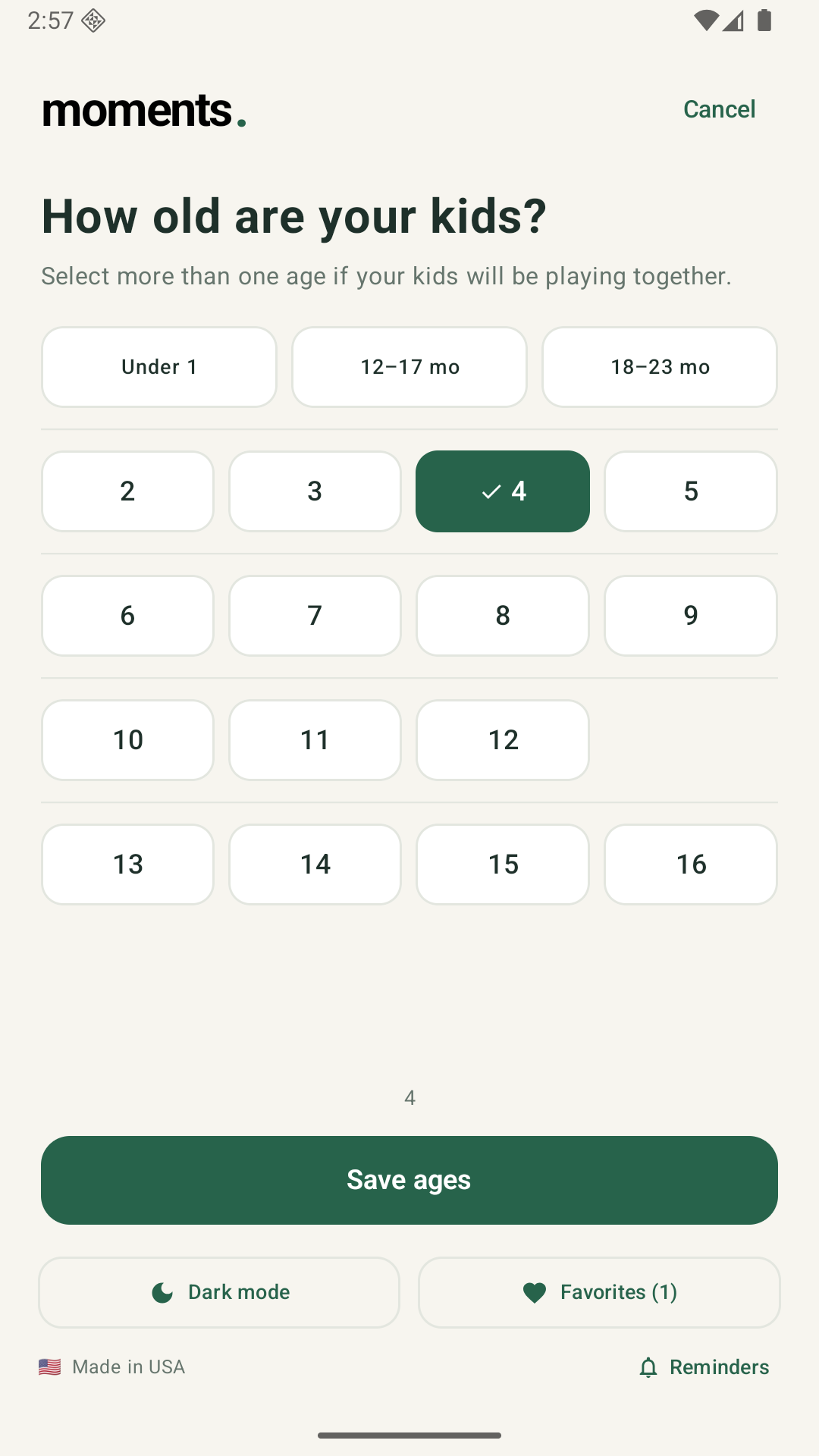
The free Moments web finder lets you select ages from under 1 through 16. For siblings or a group, select more than one age, then choose Inside or Outside and the time available.
Activities for every exact age
Choose an age for ten practical ideas: quick games at home, outdoor prompts, and flexible outings. The age is a starting point; adapt every activity to the child.
Activity ideas by broad age group
These are general starting points, not developmental assessments. Keep every activity optional and supervised as needed.
Babies under 1
Try a responsive face-to-face game: copy a coo or expression, pause, and see whether the baby responds. A caregiver can also narrate a familiar routine or sing gently. Follow safe sleep and tummy-time guidance; any floor play should be awake and supervised.
Toddlers, about 1–3
Offer a simple choice and repeatable actions: point to a color, copy a slow movement, name familiar sounds, or help place large soft toys in a basket. Avoid small loose parts and stay close to anything the child may mouth or climb.
Preschoolers, about 3–5
Try pretend play, drawing, a short movement game, or sorting familiar objects by a child-chosen feature. Let the child change the story or rules; taking turns leading keeps the activity shared rather than a lesson.
School-age children, about 6–10
Invite a child to invent clues for a simple scavenger hunt, create a paper-free story map using landmarks on a walk, or design a pretend shop. Offer choices about difficulty, movement, and whether to play together or independently nearby.
Older kids and teens, about 11–16
Ask what kind of activity sounds good instead of assuming. Co-create a recipe, photo-free observation challenge, playlist-based movement break, or short walk with a conversation prompt. Give older children room to adapt the idea or opt out.
For siblings and mixed-age groups
Choose a shared theme with different ways to join in. During a sound hunt, a younger child can point or listen while an older child names or counts sounds. During a pretend story, one child can choose a character and another can decide what happens next. Avoid requiring children to perform at the same speed or in the same way.
For shared play with siblings, see our guide to activities for mixed-age groups.
Use age filters as a starting point
The free Moments web finder narrows activity ideas by age, inside or outside, and the time you have. The upcoming app is planned to add favorites and optional reminders. These filters are intended as a starting point; adults remain the best judges of what fits a particular child and moment.
More helpful activity guides
- Indoor activities for kids
- Outdoor activities for kids
- Activities with grandparents
- Activities for childcare groups
Find an activity that fits your group.
Select one or more ages, then set the place and time.
Try the free activity finder